

Theine vs caffeine: Natural Energy in Tea & Coffee

If you’ve ever wondered about the difference between theine and caffeine, you’re not alone. While both refer to the same natural stimulant and the same chemical compound, how they behave in your body—and how they make you feel—can be very different. In this guide, we’ll explore theine vs caffeine, where to find them, and how to use them correctly as natural energy boosters in daily life and to create a balanced life with valuable calm energy, mindful living, and natural wellness.

For all my tea enthusiasts and coffee drinkers, this is an article to find out the difference between theine and caffeine, what to be aware of, and finally, how to use them in a well-balanced life as natural energy boosters.
Feeling busy? Jump to conclusion.
What are caffeine and theine?
Caffeine and theine are often talked about as if they’re two different compounds, but chemically, they’re exactly the same. The difference lies in how they’re absorbed and experienced, largely due to the source. In tea, this compound is called theine; in coffee, it’s referred to as caffeine. Let’s take a closer look at both to understand how they work in our favorite drinks.
What is caffeine? (And where else it’s found)
Caffeine is a chemical name of a compound found in coffee, tea, and some other plants like cacao, Yerba mate, and guarana. Commonly, people associate caffeine only with coffee, though we know it is present in so many ingredients. Caffeine is known and used as an energy booster, but it has several effects that we’ll go through later in this article.
What is theine?
Also, tea contains caffeine, which is also known as theine, although at lower concentrations. Theine is actually the name of the caffeine found specifically in tea, even though it has the same meaning and is less commonly used. 19th century, the scientist who found it named it theine, before it was discovered that it is chemically the same as caffeine. Don’t mix up theine with L-theanine, which is an amino acid, one of the many compounds found in tea.
Caffeine and theine have the same molecular structure, but different names depending on where they are found.
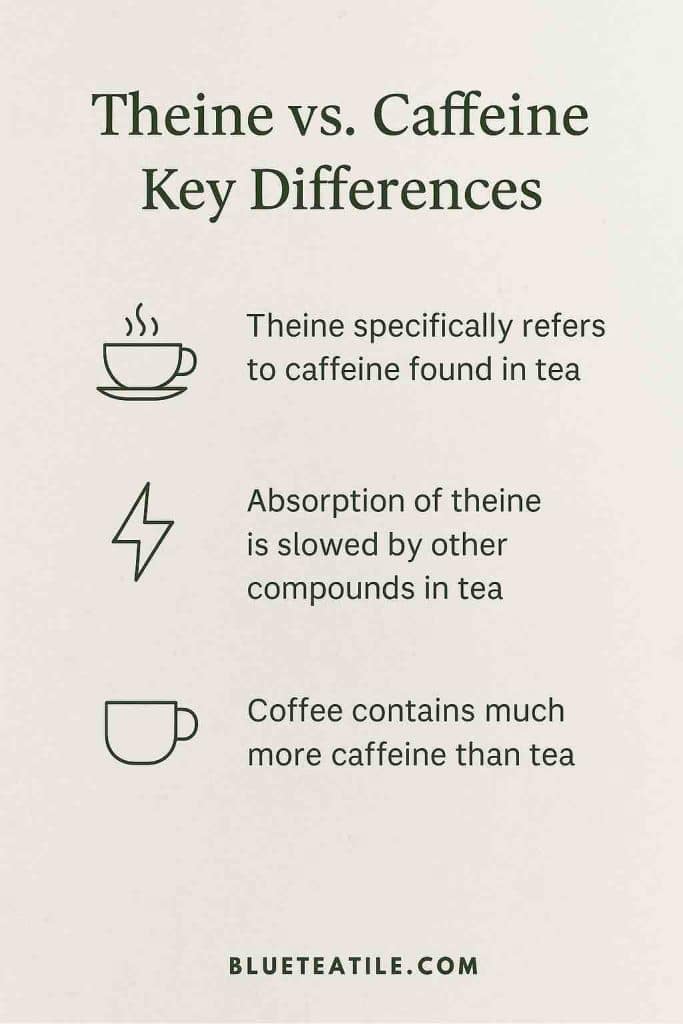
Theine vs Caffeine: Key Differences
Caffeine and theine are both names for caffeine, but theine specifically refers to caffeine found in tea. In the case of theine, tea contains other compounds that slow down theine absorption, making tea known for relaxation and coffee for an energy boost. Also, the amount of caffeine found in tea and coffee differs for coffee can contain 3 to 10 times more caffeine than tea.
Short on time?
Pin it for later!
In this article, I will use the term “theine“ when referring to caffeine and the caffeine content found in tea, and “caffeine” when referring to caffeine in coffee or other plants besides the tea plant. If the discussion is general, I’ll use “caffeine” well, not to write both and bore you, and to keep it more clear and on point.
Next, we go through the different effects of theine and caffeine in the human body, the recommended daily consumption, health benefits, the examples of tea types with high and low theine content, and coffees with their caffeine content, with a few words about decaffeinated coffee, with some perfect recipes for both tea and coffee beverages. Lastly, we’ll explore options for choosing coffee, tea, and herbal tea to utilize caffeine and theine as natural energy boosters at the correct times and moments.
How theine vs caffeine affects your energy
Caffeine gives a quicker energy boost and alertness. It can make falling asleep harder. Absorption of caffeine is quick, which can cause a crash in energy afterwards, too. We associate coffee with a fast-paced lifestyle.
While caffeine is the quick energy, theine gives a more calming energy. First of all, tea beverage contains less caffeine than a cup of coffee. Tea contains tannins that slow down the absorption of theine and release energy more calmly.
Tea also contains the amino acid L-theanine, which promotes relaxation and focus. We associate tea with a natural lifestyle, though both coffee and tea are good companions for those who want to balance their energy more naturally.
The main difference between caffeine and theine as an energy booster is the reaction time of the stimulating effect in the body. Coffee has fast energising effects, while tea releases the energy more slowly, thanks to the other compounds found in tea.
| RELATED: Cold Plunge In The Wild: Boost Energy And Seasonal Balance
Did you know that although tea leaves generally have more caffeine than coffee beans, a cup of coffee actually ends up with more caffeine than a cup of tea after brewing?
Daily consumption and caffeine intake
To keep it on the healthy side, about 400 mg of caffeine per day is good for your health. So go ahead, 4 to 5 cups a day ain’t gonna kill you – it’s just good for you (depending on how strong your brew is).
A study about The Safety of Ingested Caffeine shows, though, that it estimates that 85% of adults in the U.S. consume about two cups of coffee over the suggested amount, which often brings their caffeine intake well beyond the recommended 400 mg, especially when factoring in other sources like tea, chocolate, energy drinks, or soft drinks.
Here in Nordic countries, the consumption is quite high too. With an average of 9,6 kg of coffee yearly per person in Finland, which is seriously quite much if you compare it to the U.S. with 3,1 kg (per person per year). In any listing, Finland ranks high in the of consumption and caffeine quantities.
So while caffeine in moderation is fine, it’s worth being mindful of the total amount you’re consuming throughout the day, particularly if you’re feeling jittery, anxious, or having trouble sleeping.
Health benefits (and risks) of caffeine
Caffeine is a natural stimulant that gives you energy by activating the central nervous system (CNS). According to a review (2019) of 40 different studies, it would be beneficial to your health to drink 2 to 4 cups of coffee daily, and it could reduce the risk of death.
So, mainly, do not go overboard. If you start drinking too much coffee and your body absorbs too much caffeine per day, more than the 5 cups, it turns around and increases the risk of death. Bad news rarely comes alone, and so do the adverse effects of caffeine: anxiety, restlessness, sleeping problems, high blood pressure, even heart attacks, to name a few.
Caffeine can be a risk during pregnancy, or not?
Caffeine is generally not recommended for pregnant women. Drinking high amounts of caffeine or caffeinated drinks may lead to a smaller birth size, miscarriage, or other pregnancy problems. Generally, a small dose of caffeine, a consumption of 1 to 2 cups of coffee a day during pregnancy, is something you shouldn’t worry about.
Why the right amount of caffeine is actually good for you
You’ve likely heard mixed messages about caffeine—one day it’s good for you, the next it’s not. But when consumed mindfully, caffeine (from both coffee and tea) can be part of a healthy, balanced, natural lifestyle.
Caffeine is rich in antioxidants, which help fight inflammation in the body and may even lower the risk of certain chronic illnesses. It’s also known to improve mental focus and alertness—hello, productivity! Some studies show that moderate caffeine intake may support heart health and reduce the risk of stroke or heart disease. In fact, research from Johns Hopkins suggests caffeine may also help with memory retention and brain function.
And let’s not forget the daily rituals around tea and coffee that offer a moment of pause, grounding, and comfort, wellness benefits that go far beyond the chemical ones.
So whether you sip tea or enjoy a morning coffee, it’s not just about the caffeine content. It’s about how you enjoy it and how it supports your energy in a way that feels good to you.

What impacts the caffeine levels in tea and coffee
Choosing a variety of coffee or tea is the starting point, as the caffeine content varies between them. Under the next headers, we go through the caffeine and theine contents in different teas and coffees.
In addition to varieties, the roasting or brewing method, steep time, serving size, and how much coffee grounds are used in brewing can all affect the quantity of caffeine in finished coffee or tea. Also, for example, if you serve your coffee or tea with milk, it will dilute the beverage and decrease the caffeine content.
If you are smoking or using alcohol, notice that your liver might be using up the caffeine faster. Which means, evidently, that if you are slightly hooked on caffeine, you then want to drink a few cups more and probably will exceed the recommended limit of intake more easily.
Caffeine content in different tea types
Do all teas contain theine then? Yes. Though all teas do contain theine, don’t mix them up with herbal teas. For clarity, all true teas, the tea made from the leaves of the tea plant Camellia Sinensis, contain theine in various levels. Herbal teas, which are more correctly called infusions, are made from other plants and various parts of the plants, and they do not contain theine, with a few exceptions.
The theine content depends on the type of tea because the tea leaves are processed differently. The less tea is processed, the lower its theine content. The more processed and oxidised teas contain much theine.

Short on time?
Pin it for later!
| LOW THEINE TEAS Teas with 15 to 45 mg theine per 240ml (8oz) serving | HIGH THEINE TEAS Teas with 40 to 70 mg theine per 240ml (8oz) serving |
| White tea | Oolong tea |
| Green tea | Black tea |
| Yellow tea | Pu’ehr tea |
| Matcha tea |
Notice still that the quantity might vary depending on what you serve the tea, how strong you make your brew, or if you are using a tea blend that mixes some dried fruits or spices with the tea leaves.
| RELATED: Ultimate guide on how to brew perfect loose leaf tea
Tea recipes
When you are looking for teas to steep in this natural lifestyle blog, you have several options. I suggest starting with the steaming hot sweet tea, the classic Moroccan Mint Tea with green tea leaves, or my cold twist of it, the refreshing iced mint tea. If you prefer a more traditional style, try out the Iced black tea with honey and lemon!
| RELATED: Find the best books about tea
Theine-Free Teas and Herbal Infusions
When you are looking for theine-free tea (or caffeine-free tea), choose herbal teas and infusions. For example:
- Chamomile
- Mint
- Thyme
- Lemon balm
- Rooibos
- Dandelion root
- Hibiscus
One exception, though. Yerba Mate, a South American Herb that is commonly used in infusions, does contain theine, and has a similar flavor to the true teas made from the Camellia Sinensis tea plant.
Try these theine-free herbal tea recipes!
| RELATED: How to brew Herbal tea | Steeping a perfect herbal infusion
Caffeine content in coffee and decaf options
All coffee contains caffeine, whether it has been extracted from it. A regular cup of coffee contains about 80 to 100 mg of caffeine per serving (240ml / 8oz). So beware, if you have a half-liter coffee mug as your regular coffee cup, you end up getting twice as much caffeine!
There are two most common coffee beans in use: arabica and robusta. They differ in flavour as well as in caffeine content. According to a study (2016), the arabica coffee bean contains only half as much caffeine as the robusta variety.
Caffeine content per 240 ml (8 oz)
- Brewed coffee 80 to 100 mg
- Espresso 63 mg
- Cold brew 102 to 158 mg*
- Decaf coffee 2 to 15 mg
*Brewed in water at room temperature for 8-24 hours.
Short on time?
Pin it for later!

Notice, too, that even caffeine-free coffee contains caffeine, for it cannot be removed completely.
Decaffeinated coffee
The decaffeinated coffee does contain caffeine in a small amount. In the process, 98% of caffeine is removed, so almost all. It is up to you to decide whether or not the caffeine-free coffee is for you.
Try these coffee recipes!
Mix up spiced coffee grounds to give as a gift or enjoy at home, or brew a simple Iced coffee using the French press method. If you are feeling more festive, shake a Moroccan spiced coffee mocktail for indulgence.
| RELATED: Simple homemade iced mint latte
When to choose the right beverage for every moment

Short on time?
Pin it for later!
- Want alertness and a strong energy boost fast? Choose coffee.
- Need gentle focus and calm? Drink some tea.
- Avoiding caffeine altogether? Pick an herbal tea.
Conclusion: Balanced Energy, Naturally
Caffeine—whether it comes through a strong cup of coffee or a gently energizing tea—is a natural stimulant that, when used mindfully, can truly support your day-to-day rhythm. Theine and caffeine are chemically the same, but the way they’re delivered through different drinks makes all the difference.
Use that knowledge to your advantage: let coffee fuel your busy mornings, and let tea support your focus, creativity, or winding-down moments. And if you’re craving a cozy cup without any stimulation, herbal teas are always a beautiful, theine-free alternative.
Know your body, notice how different drinks affect your energy, and choose what feels aligned. Your daily beverage can be so much more than a natural habit—it can be a little wellness ritual, naturally nourishing your day.


